
Perfect Square Number Chart
A perfect square is a number made by multiplying a whole number by itself — 1, 4, 9, 16, 25 and so on. Use the chart to look up squares up to any limit, check whether a number is a perfect square, find the nearest squares either side of it, and print a clean chart for the classroom or homework folder.
- Free to use
- No sign-up
- Runs in your browser
Quick answer
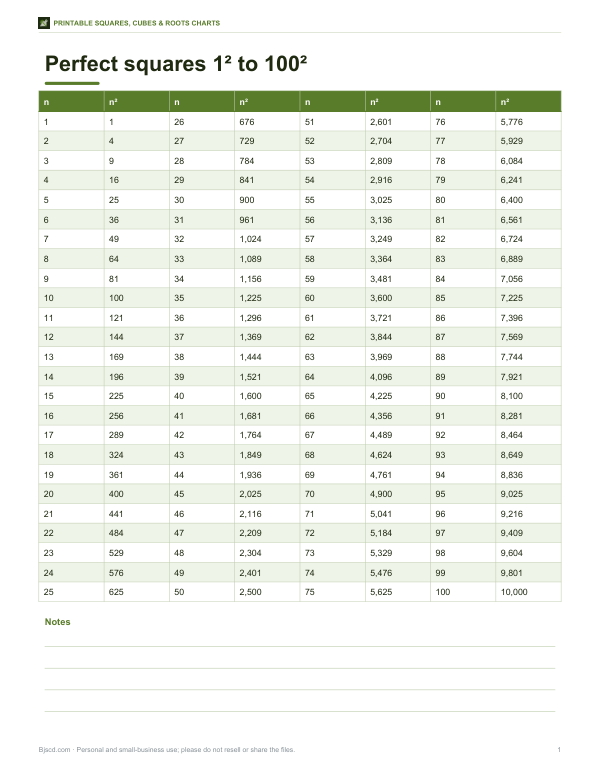
A perfect square chart 1–100 lists the squares of whole numbers from 1² to 100², ending at 10,000. For quick checks: 38 is not a perfect square because it falls between 6² = 36 and 7² = 49. 115 is not a perfect square because it falls between 10² = 100 and 11² = 121.
Perfect square chart and checker
Printable Squares, Cubes & Roots Charts
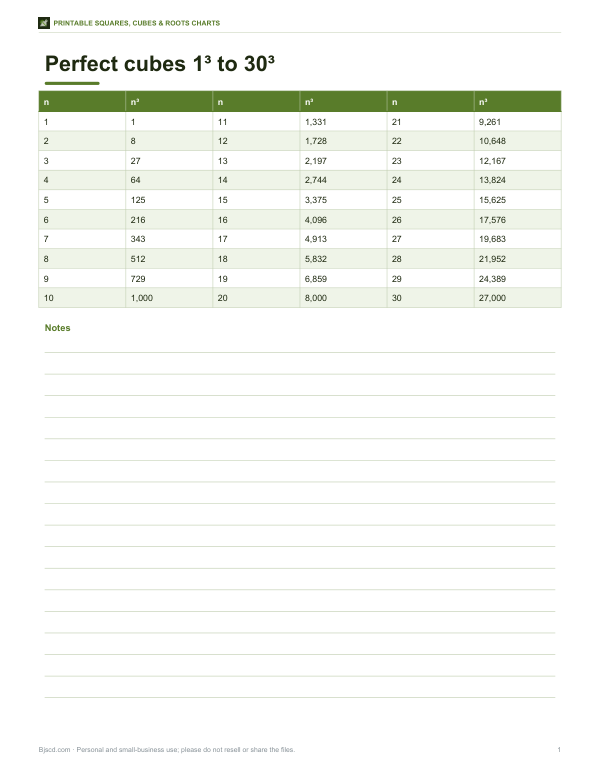
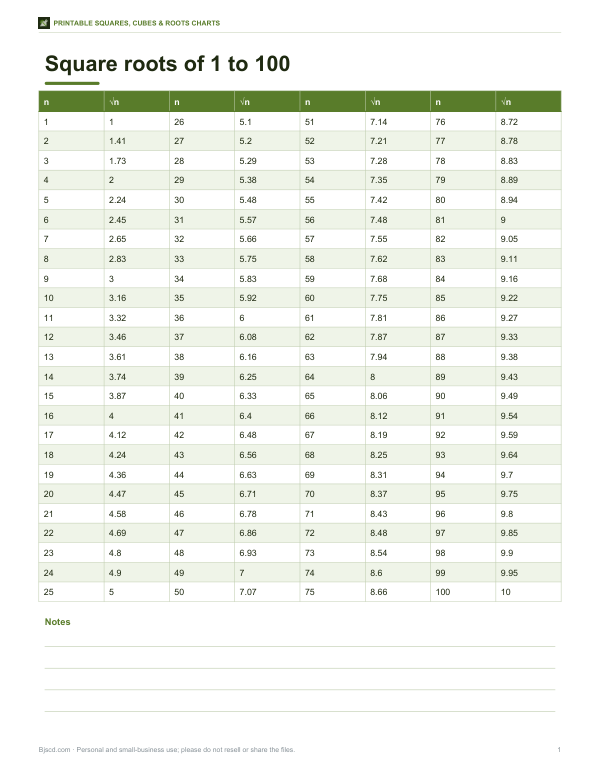
Printable perfect squares chart 1–100, cubes chart 1–30, square roots table to 3 decimals, a 100-chart square-pattern activity and a practice worksheet with answer key.
- Squares 1–100 (PDF, XLSX)
- Cubes 1–30 (PDF)
- Square roots 1–100 (PDF)
- Practice worksheet with key (PDF, DOCX)
Formats: PDF, XLSX, DOCX. Instant download after payment (link valid 72 hours, up to 5 downloads). AI-assisted: the templates were drafted with AI help and reviewed and laid out before publishing.
$5.00 USD, one-time 4 files · about $1.25 each
- Instant download
- 7-day refund
- Secure checkout by Stripe
7-day money-back guarantee. Full refund within 7 days of purchase, even after you download.
Free sample: Perfect Cubes 1 30 (PDF, 96 KB)
Full refund within 7 days — see the refund policy and license.
Free printables
Single sheets you can print right now, no sign-up. The full pack adds every sheet in one download plus the editable files.
 Printable Perfect Square Practice Worksheet
Perfect squares list 1 to 20
Use this short perfect square table for quick lookup and memorization.
| n | n² | n | n² |
|---|---|---|---|
| 1 | 1 | 11 | 121 |
| 2 | 4 | 12 | 144 |
| 3 | 9 | 13 | 169 |
| 4 | 16 | 14 | 196 |
| 5 | 25 | 15 | 225 |
| 6 | 36 | 16 | 256 |
| 7 | 49 | 17 | 289 |
| 8 | 64 | 18 | 324 |
| 9 | 81 | 19 | 361 |
| 10 | 100 | 20 | 400 |
What is a perfect square?
A perfect square is the product of a whole number with itself: n × n, written n². The first perfect squares are 0, 1, 4, 9, 16, 25, 36, 49, 64, 81 and 100. They are called squares because that many dots can be arranged in a square — 16 dots make a 4 by 4 square. The square root of a perfect square is a whole number; the square root of any other positive whole number is irrational, with a decimal that never ends or repeats.
Perfect squares from 1 to 30
| n | n² | n | n² | n | n² |
|---|---|---|---|---|---|
| 1 | 1 | 11 | 121 | 21 | 441 |
| 2 | 4 | 12 | 144 | 22 | 484 |
| 3 | 9 | 13 | 169 | 23 | 529 |
| 4 | 16 | 14 | 196 | 24 | 576 |
| 5 | 25 | 15 | 225 | 25 | 625 |
| 6 | 36 | 16 | 256 | 26 | 676 |
| 7 | 49 | 17 | 289 | 27 | 729 |
| 8 | 64 | 18 | 324 | 28 | 784 |
| 9 | 81 | 19 | 361 | 29 | 841 |
| 10 | 100 | 20 | 400 | 30 | 900 |
Use the chart above to extend the list to any limit up to 1,000² = 1,000,000, and include cubes if you need them.
Patterns in perfect squares
- Odd-number sums — every square is the sum of consecutive odd numbers: 1 + 3 + 5 + 7 = 16 = 4².
- Differences — the gap between consecutive squares grows by 2 each time: 1, 4, 9, 16 differ by 3, 5, 7. In general (n + 1)² − n² = 2n + 1.
- Last digits — perfect squares can only end in 0, 1, 4, 5, 6 or 9. A number ending in 2, 3, 7 or 8 is never a perfect square.
- Even and odd — even numbers have even squares; odd numbers have odd squares.
- Squares ending in 5 — for a number ending in 5, multiply the tens part by the next number and append 25: 35² → 3 × 4 = 12, so 1,225.
- Zeros — a perfect square ending in zeros always has an even number of them (100, 10,000).
How to check whether a number is a perfect square
- Check the last digit: if it is 2, 3, 7 or 8, stop — it is not a square.
- Estimate the square root using known squares: 1,764 lies between 40² = 1,600 and 50² = 2,500.
- Use the last digit to narrow down: a square ending in 4 has a root ending in 2 or 8, so try 42 and 48.
- Check: 42² = 1,764. It is a perfect square.
For large numbers, prime factorisation also works: a number is a perfect square if every prime in its factorisation appears an even number of times. 1,764 = 2² × 3² × 7², so √1,764 = 2 × 3 × 7 = 42.
Estimating square roots
For numbers that are not perfect squares, find the two nearest squares and interpolate. √50 lies between 7 (49) and 8 (64); 50 is 1 of the 15 steps from 49 to 64, so √50 ≈ 7 + 1/15 ≈ 7.07. The true value is 7.0711. This estimation skill is useful for checking calculator answers and for mental maths.
Where perfect squares are used
- Area — a square room 12 ft on each side has an area of 144 sq ft.
- Pythagoras’ theorem — a² + b² = c²; the 3-4-5 triangle works because 9 + 16 = 25.
- Quadratic equations — completing the square and factoring differences of squares.
- Statistics — variance and standard deviation are built from squared differences.
- Computing — screen resolutions, grid layouts and square matrices.
Teaching ideas
Have students build squares with counters or grid paper to see why the numbers grow as they do. Colour perfect squares on a 100 chart and look at the pattern of gaps. Challenge students to find the square root of a number such as 2,025 using the last-digit trick and nearest squares. Quick recall of squares up to 15² or 20² makes later topics — Pythagoras, quadratics, square roots — much easier.
Squares of numbers ending in 5 and near 50
Mental maths tricks make squares quick to work out. For numbers ending in 5, multiply the tens digit by one more than itself and append 25: 65² → 6 × 7 = 42, giving 4,225. For numbers near 50, use (50 + d)² = 2,500 + 100d + d²: 53² = 2,500 + 300 + 9 = 2,809. For numbers near 100, (100 − d)² = 10,000 − 200d + d²: 97² = 10,000 − 600 + 9 = 9,409. Practising these builds number sense and makes checking answers fast.
Worked example
Is 1,764 a perfect square? It ends in 4, so it could be. 40² = 1,600 and 50² = 2,500, so the root is in the 40s. Squares ending in 4 come from numbers ending in 2 or 8. 42² = 1,764 — yes. The checker confirms it, shows the neighbouring squares 41² = 1,681 and 43² = 1,849, and the chart set to 50 with 10 columns lists all squares from 1 to 2,500 for printing.
Frequently asked questions
Is 115 a perfect square?
No. 115 is between 10² = 100 and 11² = 121, so its square root is not a whole number.
Is 38 a perfect square?
No. 38 is between 6² = 36 and 7² = 49, so it is not a perfect square.
What is the perfect squares list 1 to 20?
The squares from 1 to 20 are 1, 4, 9, 16, 25, 36, 49, 64, 81, 100, 121, 144, 169, 196, 225, 256, 289, 324, 361 and 400.
What are the perfect squares from 1 to 100?
1, 4, 9, 16, 25, 36, 49, 64, 81 and 100.
Is 0 a perfect square?
Yes, 0 = 0².
How many perfect squares are there below 1,000?
31 (1² to 31² = 961), or 32 counting 0.
Can a perfect square end in 7?
No. Perfect squares end in 0, 1, 4, 5, 6 or 9.
How do I find the square root of a perfect square?
Use nearest known squares and the last digit, or prime factorisation.
Can I print the chart?
Yes, choose the range and click Print chart.
What is the largest perfect square below 10,000?
9,801, which is 99²; 10,000 itself is 100².